
The rupee has depreciated by 0.6 per cent so far in the current financial year.

The fall in total reserves was mainly because of a decline in foreign currency assets worth $4.5 billion, the data showed.

Surplus liquidity in the banking system as measured by absorption of excess funds by the Reserve Bank of India (RBI) fell sharply at the end of the last week due to outflows on account of advance tax payments. According to the RBI data, the net liquidity absorbed by the central bank on September 16 was at Rs 3,243.57 crore, much lower than the average of Rs 56,809.92 crore in the preceding four days of the week. The average absorption of funds by the RBI so far in September is at Rs 1.13 trillion, against the average of Rs 1.2 trillion in the previous month, the data showed.
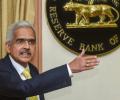
Central banking is a science, not an art, Tamal Bandyopadhyay tells RBI Governor Shaktikanta Das.

With economic activity still to reach pre-pandemic levels, the RBI may slow down the pace of rate hikes until next year to quell soaring inflation while supporting growth, the Asian Development Bank (ADB) says in its latest report. The Manila-based multilateral funding agency has raised the inflation forecast for the current fiscal year ending in March 2023 to 6.7 per cent from its earlier projection of 5.8 per cent. For the next fiscal year too, the forecast has been revised upwards to 5.8 per cent from 5 per cent earlier.

The Reserve Bank will go for a "dovish pause" at Wednesday's policy review announcement amid developments such as a rise in inflation, government maintaining the inflation target band and a likely impact on growth due to local lockdowns on rising COVID-19 infections, analysts said on Monday. Economists at American brokerage Bofa Securities said price stability, growth and financial stability will become the prime focus areas for the central bank going forward. "The RBI MPC (Monetary Policy Committee) should deliver another dovish pause on Wednesday," it said. The policy announcement, the first for the fiscal, will come days after the government maintained the RBI's target to ensure inflation to be within 2-6 per cent band for five more years.

Rupee has depreciated 8 per cent against the US dollar since beginning May'13.

Weakness of the dollar in the overseas market also boosted the rupee, a forex dealer said.

Senior bankers point out that while they will eventually attract qualified professionals, onboarding them takes time.

It is not in our interest for the rupeee to rise against the dollar in which our exports are invoiced.

The Reserve Bank of India on Friday raised the benchmark lending rate by 50 basis points to 5.40 per cent to tame inflation.

After an extremely stable 2023, the Indian rupee started 2024 on a promising note and has turned out to be the best-performing Asian currency so far in January, appreciating 0.1 per cent despite 2 per cent rise in the dollar index. All other Asian currencies depreciated by around 1.4-4 per cent during the month. The local currency regained its ground against the greenback on the back of foreign portfolio inflows, said market participants.

Already retail inflation has risen to 6.07 per cent in February, crossing the upper band of the Parliamentary mandate. This is the second consecutive month in 2022 when retail inflation has crossed the 6 per cent mark having hit 6.01 per cent in January.
Historically, the RBI has tried to keep the crooks at bay by issuing a circular a day. What it needs is more onsite supervision. Merely checking high-frequency data with the help of technology is insufficient, notes Tamal Bandyopadhyay.

Those hardest hit by the second wave of the pandemic have been blue-collared workers, doctors and healthcare workers, law and order and municipal personnel, individuals eking out daily livelihood, and small businesses. And there should be more measures taken to alleviate their pain, the Reserve Bank of India (RBI) said on Monday. The report also indicated that the RBI's growth numbers might have to be revisited as the central bank's real GDP growth projection of 26.2 per cent given in the MPC's resolution of April 7 for the first quarter of 2021-22, were "made before the full fury of the resurgence." Nevertheless, the "resurgence of COVID-19 has dented but not debilitated economic activity in the first half of Q1: 2021-22.
Credit bureaus have become a weapon banks wield even against a consumer who deserves much better.
The rupee on Monday plunged by 48 paise to hit its life-time low of Rs 57.54 in early trade on heavy dollar demand and the US currency strengthening against major rivals overseas.

What is killing the risk appetite of the bond buyers is the inconsistency in the central bank's approach. It needs to allow the yield to find its own level, gradually. To ensure that, the RBI may adopt a similar approach with which it handles a slipping rupee, asserts Tamal Bandyopadhyay.

Reserve Bank Governor Shaktikanta Das on Friday said 67 per cent of the decline in the foreign exchange reserves since April was due to valuation changes arising from strengthening US dollar and higher American bond yields. The forex reserves, which stood at $606.475 billion as on April 2, have declined to $537.5 billion as on September 23. It was also the eighth straight week when the reserves declined.
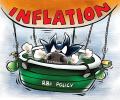
The Reserve Bank of India on Friday raised the retail inflation forecast for 2021-22 to 5.7 per cent due to supply side constraints, high crude oil and raw materials cost. The RBI in June had pegged the retail inflation estimate at 5.1 per cent for the current financial year. The RBI has the mandate to keep inflation in a band of 2-4 per cent, with a tolerance level of 2 per cent on either side.

The rally in PSBs, analysts feel, was more a knee-jerk reaction to the development, and the actual benefits will start to accrue once the addition takes place in 2024. "The actual benefit for banks from the inclusion in JP Morgan's EM Index will accrue from June 2024 onwards. "Until then, the larger fundamentals of the market will dictate the moves. "Once the initial euphoria subsides, bond markets will look to global cues which may trigger fresh selling," said Siddharth Khemka, head of retail research, Motilal Oswal Financial Services.
The rupee fell to a record low of 59.9350 to the dollar, breaching past its all-time low of 58.98 on June 11.

The rupee on Tuesday lost 11 paise to Rs 55.85 against the US dollar in early trade on the Interbank Foreign Exchange following dollar gains against other currencies overseas amid a weak trend in the equity market.

The Malegam committee on the RBI's capital adequacy had suggested that the RBI must move away from its methodology to calculate the foreign exchange gains to a weighted average cost-based valuation method. Central bank may done away with provisioning requirements, to enable higher transfer of surplus in the 2017-18 fiscal, analysts say.
From the markets' perspective, a greater predictability of the RBI's intervention will give them a space to operate in.

The domestic currency has fallen past the 56-level against the dollar after June 29.

Sentiments were weighed down as the US dollar turned higher against its major counterparts.

The International Monetary Fund (IMF) warned on Tuesday that India's general government debt (comprising both central and state government debt) could exceed 100 per cent of gross domestic product (GDP) in the medium term. It also cautioned that long-term debt sustainability risks are high due to the significant investment required to meet India's climate change mitigation targets. The Indian government, however, disagreed, arguing that risks from sovereign debt are extremely limited as it is predominantly denominated in domestic currency.

Traders suspect The Reserve Bank of India (RBI) bought bonds and actively intervened in the rupee to support sentiment.
The value of rupee has fallen by over 300 per cent since 1990.
The RBI governor is focused on growth, and keeping rupee slightly depreciated is part of that 'Atmanirbhar Bharat' strategy.

The rupee has depreciated 9.7 per cent against the US dollar over a year and with the RBI stemming the rupee's weakness through dollar sales, its reserves have dropped to their lowest levels since October, 2020. The fall in reserves has widespread implications.

April policy could be all about RBI communication.

The Reserve Bank on Monday asked all banks and financial institutions to assess the impact on their balance sheet, asset quality, liquidity, among others, in the wake of the potential threat arising out of the spread of coronavirus disease in India. Several confirmed cases have also been detected in India, which highlight the need of a co-ordinated strategy for handling the emerging situations to protect the resilience of the Indian financial system, RBI said in a notification addressed to banks, urban cooperative banks, NBFCs, payment and small finance banks.

Sitharaman also said different departments of the government are working to provide relief to industry, which could be severely impacted by the fast-spreading virus.

Hinting at further relaxation in the capital account convertibility norms, RBI Deputy Governor T Rabi Sankar on Thursday said the country is on the cusp of some fundamental shifts with regard to currency management. India has come a long way in achieving increasing levels of convertibility on the capital account and has broadly achieved the desired outcome for the policy choices in terms of achieving a stable composition of foreign capital inflow, Sankar said while addressing the Foreign Exchange Dealers' Association of India's (FEDAI) annual day meeting. Convertibility refers to the ability to convert domestic currency into foreign currencies and vice versa to make payments for balance of payments transactions.
'His (Das) approach to work seems that of working as a team with ease in communication.'

The central bank had revised its inflation forecast significantly downward in the last policy

'The private sector believes that some enablers in labour-intensive sectors like apparel, toys, tourism, and media retail, can unlock a lot of jobs.'

Numbers could be classified further into (140) marketing and (160 or 161) for service calls to easily identify the purpose of the call in the future.
